CASE STUDY: Restoring Digital Trust to Drive Qualified Lead Growth — Increasing Lead Quality, Contract Value, and Conversion Efficiency for Atlas Facilities Maintenance
CASE STUDY / Restoring Digital Trust to Drive Qualified Lead Growth — Increasing Lead Quality, Contract Value, and Conversion Efficiency for Atlas Facilities Maintenance
BACKGROUND
Atlas Facilities Maintenance is a commercial cleaning and facilities management provider operating across Oregon, Washington, and California, serving enterprise clients including the United States Postal Service and AT&T. Through established operational capacity and experience supporting large-scale commercial accounts, the company had built strong enterprise relationships and a solid reputation within a competitive facilities management market.
Despite operational success, Atlas encountered digital and marketing setbacks that began to undermine visibility and business development. Previous marketing efforts created avoidable infrastructure and communications issues, most notably the company’s website URL becoming blocked across social media platforms, limiting discoverability and restricting customer access. At the same time, inconsistent marketing execution and messaging failed to accurately reflect the sophistication and scale of Atlas’s enterprise capabilities.
Recognizing the need for strategic intervention to stabilize and strengthen its market position, Atlas engaged Grozina to resolve these barriers, restore digital credibility, align brand positioning with enterprise-level operations, and build a stronger marketing foundation to support future growth.
CHALLENGE
The immediate challenge was maintaining visibility and qualified lead generation while Atlas’s website URL remained blocked across social media platforms — a significant disruption in an industry where digital accessibility and platform trust influence commercial opportunities. The restriction limited discoverability, weakened customer access, and created friction across marketing channels at a time when the business still needed to sustain growth and enterprise lead flow.
Compounding the issue, resolving the platform restriction proved far more complex and time-intensive than anticipated. The matter required extensive compliance correction, technical remediation, and ongoing appeals, making an immediate resolution unrealistic. Rather than pausing growth efforts until the issue was resolved, the challenge became maintaining momentum under constrained conditions.
At the same time, Atlas’s broader digital presence and communications no longer reflected the caliber of enterprise clients the company already served or the scale of its operational capabilities. The engagement therefore evolved beyond technical remediation into a parallel strategy: resolve platform barriers while simultaneously building alternative lead-generation pathways, strengthening positioning, and improving lead quality so the business could continue acquiring higher-value commercial opportunities despite ongoing visibility limitations.
STRATEGIC APPROACH
- Decided to pursue a dual-track strategy rather than wait for platform resolution because the business could not afford a prolonged interruption in lead generation. While compliance corrections, technical remediation, and appeals were actively pursued to restore the blocked website URL, marketing efforts shifted toward channels and strategies capable of generating commercial opportunities despite platform limitations.
- Decided to rebuild digital infrastructure rather than rely on short-term workarounds because fragmented website architecture, metadata, and inconsistent digital standards were weakening discoverability, conversion, and overall trust. Strengthening the technical foundation improved stability across search, advertising, and future platform performance.
- Decided to reposition marketing toward enterprise-scale lead quality rather than volume because Atlas’s operational capabilities were aligned with larger commercial contracts. Paid campaigns, landing pages, targeting, and messaging were refined to better attract and qualify higher-value commercial opportunities rather than broad, low-fit inquiries.
- Decided to strengthen authority through industry-specific content and communications because enterprise buyers evaluate vendors based on expertise, consistency, and credibility. Content strategy and newsletters were aligned with facilities management priorities to reinforce trust among commercial decision-makers during a period when platform credibility was constrained.
EXECUTION HIGHLIGHTS
- Managed ongoing compliance correction, technical remediation, and structured appeals to resolve platform-level URL restrictions while maintaining business continuity and lead generation during the recovery period.
- Rebuilt website architecture, metadata, and digital infrastructure to strengthen search visibility, conversion readiness, and long-term platform trust.
- Developed targeted paid campaigns focused on higher-value commercial contracts and enterprise-scale opportunities to offset visibility limitations caused by social platform restrictions.
- Refined landing pages, targeting, and inquiry pathways to better filter, qualify, and convert high-fit commercial prospects despite ongoing digital friction.
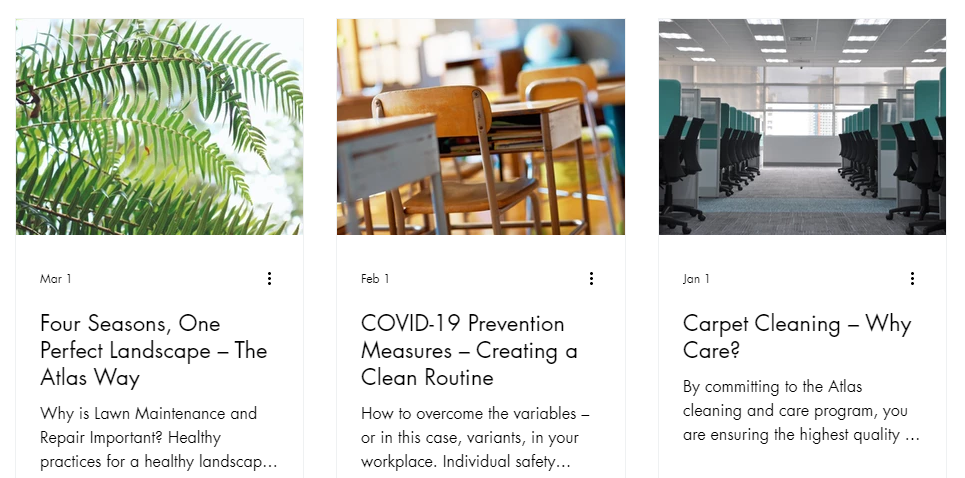
- Established an industry-focused content and newsletter cadence aligned with facilities management decision-makers and enterprise interests, producing educational and thought leadership content including OSHA Violations: Does Your Commercial Cleaning Company Follow the Protocol?, Carpet Cleaning – Why Care?, COVID-19 Prevention Measures – Creating a Clean Routine, Four Seasons, One Perfect Landscape – The Atlas Way, Post-Pandemic Changes to Implement in Your Commercial Building, and What To Look For in a Commercial Cleaning and Janitorial Company.
- Resolved platform-level URL restrictions through compliance correction and structured appeals, restoring full social media functionality and visibility.
RESULTS AND IMPACT
Despite ongoing platform restrictions and the unresolved website URL issue during much of the engagement, advertising performance improved materially, transforming paid media into a reliable source of qualified commercial opportunities at a time when visibility constraints could have significantly disrupted growth.
Through targeted digital strategy and improved lead qualification, Atlas secured commercial accounts including Southwest Hills Baptist Church, PF Chang’s, Estes LTL Freight Shipping, NW Paper Box Camas, and Galaxy Facilities as part of approximately $201,336 in total contract value, with roughly 50% directly attributable to Google Ads. Based on attributable revenue of $100,668 against $5,147 in Google advertising spend, campaigns generated an estimated 19.56x Return on Advertising Spend (ROAS), or approximately 1,955.6%.
Importantly, these outcomes were achieved while the platform restriction issue was still actively being resolved — meaning performance occurred under constrained digital conditions rather than after full restoration of visibility. Had the restriction been resolved earlier, results likely would have been amplified through stronger discoverability, lower friction, and broader inbound opportunity flow.
Sales efficiency also improved through better-qualified inbound opportunities, reducing time spent per closed deal and minimizing wasted sales effort. Most importantly, Atlas emerged not only with improved lead quality and stronger contract value, but with a more resilient digital infrastructure and marketing foundation capable of supporting long-term, profitable growth.